As an Amazon Associate, I earn from qualifying purchases. Learn more.
Reading at a desk or table sounds simple until you have done it for an hour. A book lying flat makes you hunch over it, a thick textbook keeps closing on you, and propping it against a mug works until the mug gets knocked. A good book stand fixes all of that. It holds your book at a comfortable angle, keeps the pages open and lets you sit up straight while you read, study, cook or take notes.
This guide covers what to look for in a book stand for desk or table reading, how to set it up for good posture and which real stands are worth considering. As always, we don’t invent prices or ratings: use the links to check current details on Amazon.
Why a desk book stand makes reading more comfortable
The main benefit is posture. When a book lies flat on a desk, you tilt your head forward to read it, and over time that strains your neck and upper back. Raising and angling the book brings the page closer to your line of sight so you can sit more upright. The OSHA computer workstation guidance is written for screens, but the same principles apply to reading: keep the material at a comfortable viewing distance and angle so you are not craning your neck.
A stand also frees your hands. That matters when you are taking notes, following a recipe, typing from a reference book or reading for a long time. We go deeper into posture in our guide to the best reading posture.
What to look for in a book stand for desk reading
Adjustable angle
The best stands offer several angle settings, so you can tilt the book more upright for reading and flatter for writing alongside it. More settings make it easier to fine-tune for your height, chair and desk.
Page holders that actually hold
Spring-loaded page clips or arms keep the book open without your hand on it. Check that they can handle the thickness of the books you usually read. Thick textbooks need long, strong arms, while paperbacks are easier to hold. If you mainly read big books, our guide to book stands for large textbooks covers that in more detail.
A deep enough ledge
The bottom ledge carries the weight of the book. A shallow ledge is fine for a paperback but can tip a heavy hardcover forward. Look for a ledge deep enough for your thickest book.
Stability and weight
Metal stands are usually slim and sturdy and can fold flat. Bamboo and wood stands look warmer on a desk and are often a little heavier, which helps with stability. Either works. What matters is that the base does not wobble when you turn a page.
Portability
If you study in a library or café, a stand that folds flat into a bag is a big plus. We have a separate guide to the best portable book stands if travel is your priority.
Book stands for desk reading to consider
The stands below are real products listed on Amazon. We describe them from their listed features. Check the product pages for current prices, sizes and colour options.
Camelmother Metal Book Holder Adjustable Book Stand
This is an adjustable metal book stand designed for textbooks, cookbooks and other reading at a desk. Metal stands like this tend to be slim, sturdy and easy to fold away, which makes them a good choice for students and anyone with a busy desk. Check the listing for the number of angle settings and the size of the page clips.
Best for: students and home workers who want a sturdy, foldable stand for everyday reading.

Check current price of the Camelmother Book Stand on Amazon
wishacc Bamboo Book Stand with Page Clips
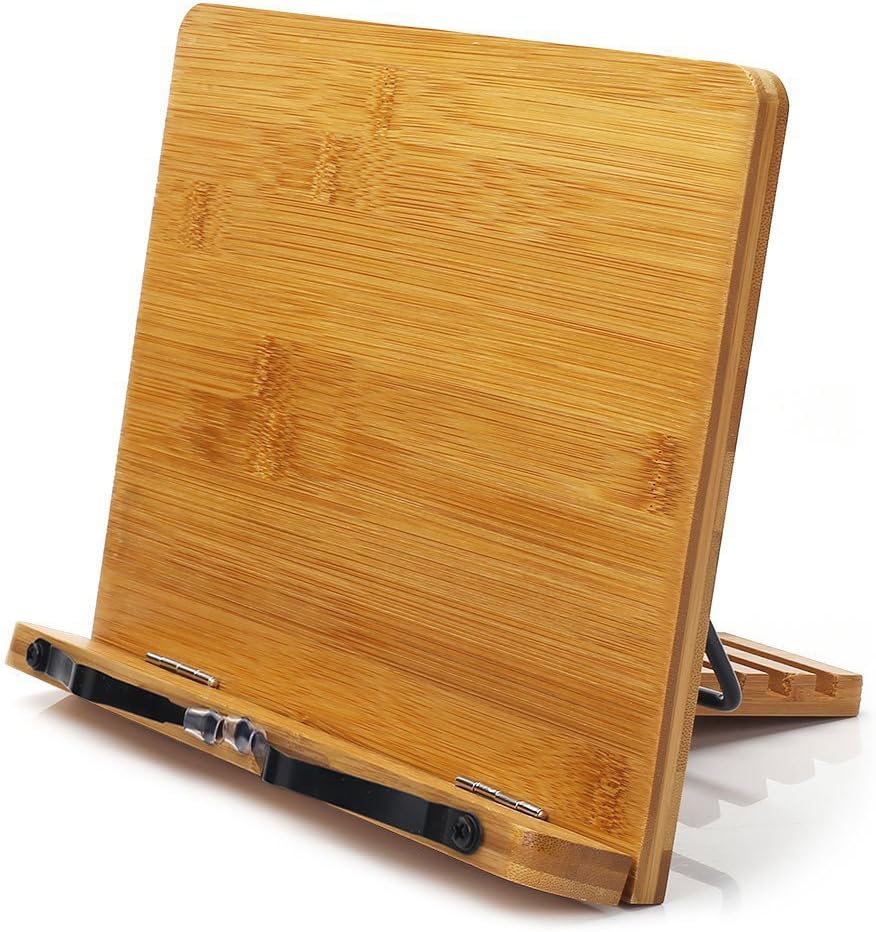
The wishacc stand is made of bamboo, with an adjustable tray and paper clips to keep the pages open. Bamboo looks attractive on a desk or kitchen counter, and a wider tray holds bigger books well. It is listed as suitable for cookbooks too, so it doubles as a kitchen stand.
Best for: readers who want a warm wood look and a stand that also works in the kitchen.
Check current price of the wishacc Bamboo Book Stand on Amazon
OUNONA Adjustable Hands-Free Reading Bracket
The OUNONA is a compact, adjustable book holder and page clip. It is smaller and lighter than a full desk stand, so it suits paperbacks and travel. We looked at a similar compact design in our Gimble book holder review.
Best for: paperback readers who want something small, light and easy to carry.

Check current price of the OUNONA Book Holder on Amazon
Mind Reader Lap Desk with Cushion
Not every reader sits at a desk. If you read on the sofa or in an armchair, a lap desk gives you a stable surface to rest a book or a small stand on. This Mind Reader lap desk is collapsible and has a cushion underneath, and it can carry a book stand on top for a more upright angle.
Best for: readers who want desk-style comfort on a sofa or armchair.

Check current price of the Mind Reader Lap Desk on Amazon
How to set up your desk book stand for good posture
A stand helps most when it is set up properly. Try these steps:
- Sit back in your chair with your feet flat and shoulders relaxed.
- Place the stand straight in front of you, about an arm’s length away or slightly closer.
- Tilt the stand until the page faces you and you can read the top line without tipping your head down very far.
- Raise the stand if you can. A box or a stack of books under the stand raises the page closer to eye level.
- Light the page from the side or above to avoid shadows and glare. A good desk lamp makes a big difference. Our LAMPAT desk lamp review and our guide to the best reading lamps for poor eyesight are good places to start.
- Take breaks. Look up and away every so often, stand up and stretch. Our guide on taking breaks while reading explains why it helps.
Book stands for different kinds of reading
Studying and textbooks
Students get the most out of a desk book stand. Keeping a textbook open beside a notebook or laptop saves constant repositioning. Look for a large, strong stand with long page arms and a deep ledge.
Cookbooks
In the kitchen, a stand keeps a cookbook open, upright and away from spills. Bamboo stands are popular here. Many have a clear splash guard, so check the listing if you want one.
Reading for pleasure
For novels and paperbacks, a smaller stand is enough. It is especially handy if you like to read while eating, or if holding a book for long periods tires your hands.
Reading with limited grip or mobility
For readers with arthritis, tremors or other grip difficulties, a stand can be the difference between reading comfortably and not reading at all. We have written guides on book holders for the elderly and book holders for Parkinson’s patients with specific suggestions.
Desk stand vs bed book holder
A desk stand is designed to sit on a flat, hard surface. It is not usually the best option for reading in bed, where you need something that can hold a book above you or beside you. For that, see our guide to book holders for reading in bed and our LEVO book holder review.
Common mistakes when using a book stand
- Setting the stand too flat. If you still find yourself leaning forward, tilt it more upright.
- Placing it off to one side. Reading with your head turned for long periods can strain your neck, so keep the stand centred whenever you can.
- Overloading a small stand. A compact paperback stand can tip over under a heavy textbook. Match the stand to your heaviest book.
- Ignoring glare. Glossy pages and tablet screens can reflect a lamp placed directly in front of you. Move the light to the side.
- Forgetting the chair. A stand cannot fix a chair that is too low or too high for your desk. Adjust the chair first, then the stand.
Frequently asked questions
Will a book stand hold a heavy textbook?
Many will, but check the listing. Look for a deep ledge, strong page arms and a stable base. Lightweight, compact stands are better suited to paperbacks.
Can I use a book stand for a tablet or e-reader?
Yes. Most desk book stands also hold tablets and e-readers. Just make sure the ledge and clips will not scratch the device or cover the screen.
Metal or bamboo: which is better?
Both work well. Metal stands are often slimmer and fold flatter for travel. Bamboo stands look warmer on a desk or kitchen counter and are often a little more stable. Choose based on where you will use the stand most.
The bottom line
A desk book stand is a small, inexpensive change that can make long reading and study sessions far more comfortable. Choose one with an adjustable angle, strong page holders and a stable base, set it up so you are not looking down at a steep angle, and add good lighting. Your neck and shoulders will thank you.